le 27 novembre 2025
11h00 - Salle Picasso
GREDEG
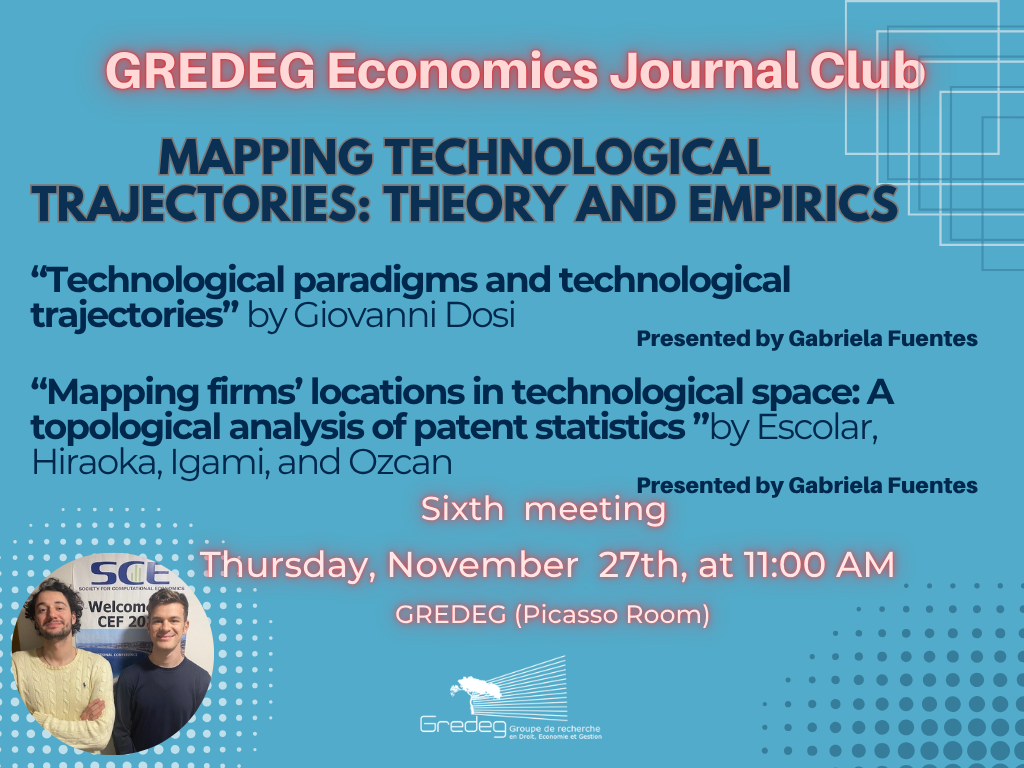
The meeting will take place on November, 27th at 11:00 in Picasso Room
In this session, Gabriela Fuentes will present the seminal paper “Technological paradigms and technological trajectories” by Giovanni Dosi (Abstract 1 below).As a complementary reading, we will discuss the paper “Mapping firms’ locations in technological space: A topological analysis of patent statistics” by Escolar, Hiraoka, Igami, and Ozcan (Abstract 2 below). Both papers are attached for your reference.
This session will offer a fascinating look at how technological innovation evolves—combining theory with cutting-edge empirical approaches to understanding how firms move through and shape technological space.
We look forward to seeing you there and sharing an engaging discussion!
ABSTRACT 1
“Technological paradigms and technological trajectories: A suggested interpretation of the determinants and directions of technical change”
The procedures and the nature of “technologies” are suggested to be broadly similar to those which characterize “science”. In particular, there appear to be “technological paradigms” (or research programmes) performing a similar role to “scientific paradigms” (or research programmes). The model tries to account for both continuous changes and discontinuities in technological innovation. Continuous changes are often related to progress along a technological trajectory defined by a technological paradigm, while discontinuities are associated with the emergence of a new paradigm. One-directional explanations of the innovative process, and in particular those assuming “the market” as the prime mover, are inadequate to explain the emergence of new technological paradigms. The origin of the latter stems from the interplay between scientific advances, economic factors, institutional variables, and unsolved difficulties on established technological paths. The model tries to establish a sufficiently general framework which accounts for all these factors and to define the process of selection of new technological paradigms among a greater set of notionally possible ones.
The history of a technology is contextual to the history of the industrial structures associated with that technology. The emergence of a new paradigm is often related to new “schumpeterian” companies, while its establishment often shows also a process of oligopolistic stabilization.
ABSTRACT 2
“Mapping firms’ locations in technological space: A topological analysis of patent statistics”
Where do firms innovate? Mapping their locations and directions in technological space is challenging due to its high dimensionality. We propose a new method to characterize firms’ inventive activities via topological data analysis (TDA) that represents high-dimensional data in a shape graph. Applying this method to 333 major firms’ patents in 1976–2005 reveals hitherto undocumented industry dynamics: some firms remain undifferentiated; others develop unique portfolios. Firms with unique trajectories, which we define and measure graph-theoretically as ‘‘flares’’ in the Mapper graph, tend to perform better. This association is statistically and economically significant, and continues to hold after we control for portfolio size, firm survivorship, and industry classification.